


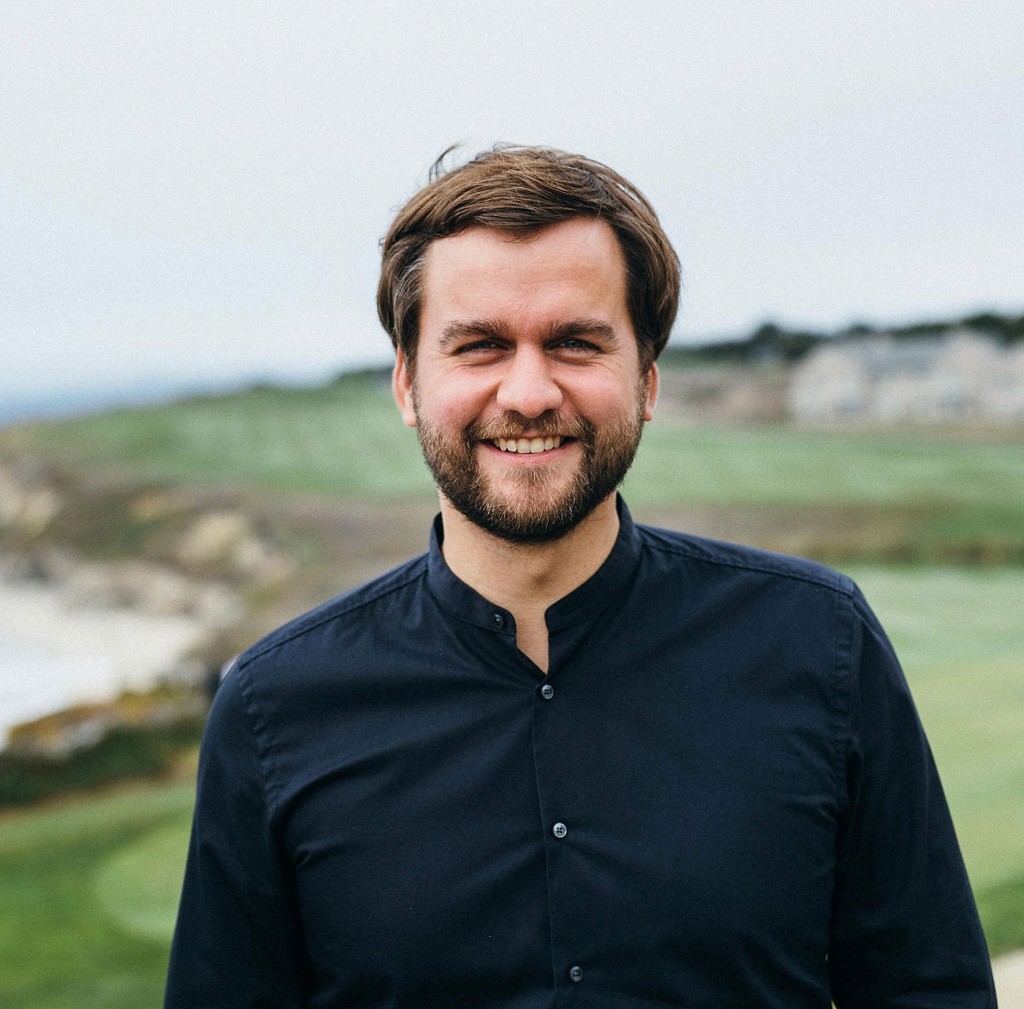
Christian Noske
March 7, 2026
The real robotics revolution is not what you think
As an investor in industrial robotics, space logistics and deep tech, Christian Noske, Partner at NGP Capital, has some idea about where we might be headed. For him, the real story is not flashy humanoids or sci-fi fantasies. It is economics, labor shortages, and infrastructure that is shifting quietly to reshape entire industries.
And this is only the beginning.
About Christian Noske
Christian Noske is a Partner at NGP Capital. He is a Berlin-based investor and operational leader with corporate, company and VC experience. He has a strong track record and trusted network with companies in the US, Europe, Asia and Israel and is interested in early growth-stage companies in enterprise software, dev-ops, industry transformation, sustainability and always seeking to make new connections. He’s also the host of the "DeepTech Unleashed" podcast.
About NGP Capital
NGP Capital backs early-stage B2B companies from Series A onwards in Europe and the US, focusing on enterprise software, industrial technology, cybersecurity, and edge & data infrastructure — sectors at the forefront of the convergence of the digital and physical worlds. With offices in Berlin, Palo Alto, Helsinki, and Geneva, the firm backs category-defining technology companies with a strong emphasis on deep tech and industrial innovation. Since the founding in 2005, the fund has grown to over $1.6B in AUM and has invested in more than 115 companies, including 18 unicorns and 11 IPOs. Their current portfolio includes ANYbotics, The Exploration Company, eGym, Lime, GetYourGuide and SecurityScorecard, while the exits include Deliveroo, Xiaomi, Moovit, Kaltura, and many more.
Humans and robots are just getting started
“Robots haven't been around humans much at all,” he says, so we’re in the early days of the relationship between humans and robots. While AMRs, logistics robots, and robotic arms have been in operation for decades on factory floors, they were largely confined to caged environments.
What’s changing now is the proximity to humans. Robots are moving out of isolated spaces and into shared environments where they operate alongside people. In factories, “we're now seeing a transition into a free flow environment where you have robots working alongside humans in more collaborative ways,” he explains.
Autonomous mobile robots are able to navigate warehouses.
Humanoids are beginning to work in the same physical space as human teams, especially “on mundane and repeatable tasks.” The emphasis among robotics start-ups remains focused on repeatable, clearly defined tasks where safety can be controlled, with AI being central to this transition. And, as robots gain greater awareness of their surroundings, collaborative use cases become more viable.
“Secondly, we’re interested in robotic use cases that are collaborative where you can use a robot for the dangerous or unhealthy tasks”. In this case, “we're talking about using robots in harsh environments or environments where safety protocols apply.”
But, for Christian and his team the priority remains investing in robots that can handle the high-risk, low (health) risk repeatable tasks first.
“Humans working with robots is a very new thing, and we're in the very early days of that.”
The breakthroughs are in cost and data
The dominant public narrative around the more widespread adoption of robotics centers on intelligence, however Christian points to more fundamental constraints: cost curves and data access.
While industrial robotics is governed by return on investment, adoption only accelerates when prices fall far enough to justify deployment at scale. It’s repetition that drives the cost reduction according to Christian. “When we’ve used a robot to do something 100,000 times, for example. That’s when the costs come down”
Equally important? Access to structured industrial data. While visual data for consumer robots is abundant online, high-resolution, task-specific industrial training data remains scarce. “You can find thousands of videos of butterflies on YouTube but you can't find a thousand videos of how to weld something together in the high resolution or other task-specific videos that could train industrial robotics,” Christian explains.
That gap limits the variety of applications that robotics can fulfil immediately, far more than raw technical capability.
What’s more, in consumer environments, tolerance levels are different. Performance doesn’t need to match decades of industrial optimization. “If a robot takes twice as long to vacuum the house when no one is home, no one cares.” Factories, however, operate under different expectations and that bar remains significantly higher.
“We need more data to get the major breakthroughs in robotics.”
The hidden driver behind acceleration
Christian observes that the surprising thing about robotics right now is that the most powerful driver of adoption is demographic changes, not only technological innovation.
Across Europe and other mature markets, aging workforces and labor shortages are creating structural gaps. Manufacturing lines are sitting partially unstaffed.
Companies face high turnover and constant rehiring cycles that erode expertise. “Ten years ago, manufacturing companies had enough labor. Now, they don't have enough labor. Everybody is retiring.”
It’s this shift that alters capital allocation decisions, and robots increasingly fill vacancies rather than replace workers. Crucially for Christian, investing in robotics, “is not about taking jobs away from humans, it's about filling the gaps.”
Christian estimates that most companies purchasing robots today are doing so for the first time. Once that initial investment proves viable, expansion typically follows.
“The labor dynamic is the biggest accelerant of deployment.”
The SpaceX moment
Another industry that Christian is investing in is space technology. Unlike in robotics, in space technology, the defining trigger has been falling launch costs. The excitement has come from the reduction in cost per kilogram to orbit as this has unlocked entirely new business models, which creates shifts in the ecosystem’s infrastructure. And, as access becomes cheaper, new layers of service and logistics emerge.
Christian attributes this development “single handedly to SpaceX, everything we're looking at in space tech and the opportunity around it is thanks to SpaceX.”
NGP has backed The Exploration Company which operates within this new paradigm, focusing on space logistics rather than launch systems themselves. “The Exploration Company is a space logistics company building on top of today’s space technology. They’re not building their own launchers. They’re bringing cargo into space and from space back to the planet.”
Space is now entering a commercial scaling phase driven by economics rather than ambition alone.
“When launch costs decline, business models that didn't previously make sense suddenly do.”
Europe’s structural edge in Deep Tech
For Christian, Europe's advantage in robotics and industrial innovation lies in proximity and density. Strong universities, deep IP foundations, and a high concentration of industrial customers create fast feedback loops. That same density also raises expectations, founders entering European industrial markets face demanding standards from established players.
“European startups really have the advantage of early access to customers,” he says. “You can go 100 kilometers in any direction, and you will probably find customers for industrial solutions. That's an infrastructure benefit for European deep tech and robotic companies because you can get quicker feedback and then improve faster.”
But the United States maintains advantages in speed and capital depth while China dominates manufacturing scale. In space, Europe continues to rely heavily on transatlantic collaboration, which currently means that without the US, European companies can’t get to space.
However, Christian believes that we should not forget the importance of collaboration, particularly in highly capital-intensive sectors. “NASA is a great example, they have been working closely with European space companies for years and built their collaboration on an exchange. It's a very good example of a transatlantic technology collaboration.”
NGP Capital has long had a presence in the US and Europe. “NGP has been around for twenty years and has always operated between the US and Europe. Also, China in the past, but not anymore. We’ve always had a Palo Alto office, and we have always had different locations in Europe. Today, Berlin is our biggest investment office, but we also have offices in Helsinki and Geneva.”
“Deep Tech in Europe is tough because customer expectations are high.”
Building with Deep Tech founders
As an investor in Deep Tech, Christian knows that founders in this space operate under fundamentally different constraints from pure software entrepreneurs.
Development cycles are longer, capital requirements in the early days are higher, and product complexity spans hardware, software, and go-to-market simultaneously.
Misalignment with customer needs carries higher consequences because iteration cycles are slower so precision matters early. To combat this, Christian and his team are “trying to push customer obsession, which means being obsessed with the customer's problems and how to solve them with your product or service pragmatically.”
For Christian, the investor's role is to understand product complexity deeply and calibrate expectations accordingly. “The biggest benefit an investor can provide is really understanding the product and the complexity properly.”
This is one of the reasons why he started the Deep Tech Unleashed podcast in October 2024.
"You can't iterate casually like in pure software. You have to get it right."
Quick-fire round
A tool you can’t live without?
“My phone.”
How do you recharge?
“Riding my motorcycle. I have a BMW GS 1250”
Advice that stuck:
“Don’t take yourself too seriously.”
Founder or start-up that you admire:
“The founder I most admire is Hélène Huby, CEO of The Exploration Company. We don't have enough women in deep tech. She's a mother of four building a fundamental company for Europe with extraordinary ambition. That deserves applause."
Christian began his venture capital career in the US, where he learned the importance of giving back. It’s something he still carries with him today, a belief that supporting founders, especially those building in deep tech, creates its own kind of karma.
For teams navigating tough technical or commercial challenges, he makes himself available for advice, and is “just a message away.” And, for founders raising a Series A or B, he encourages them to reach out directly via LinkedIn, he’s always open to connecting and helping where he can.