


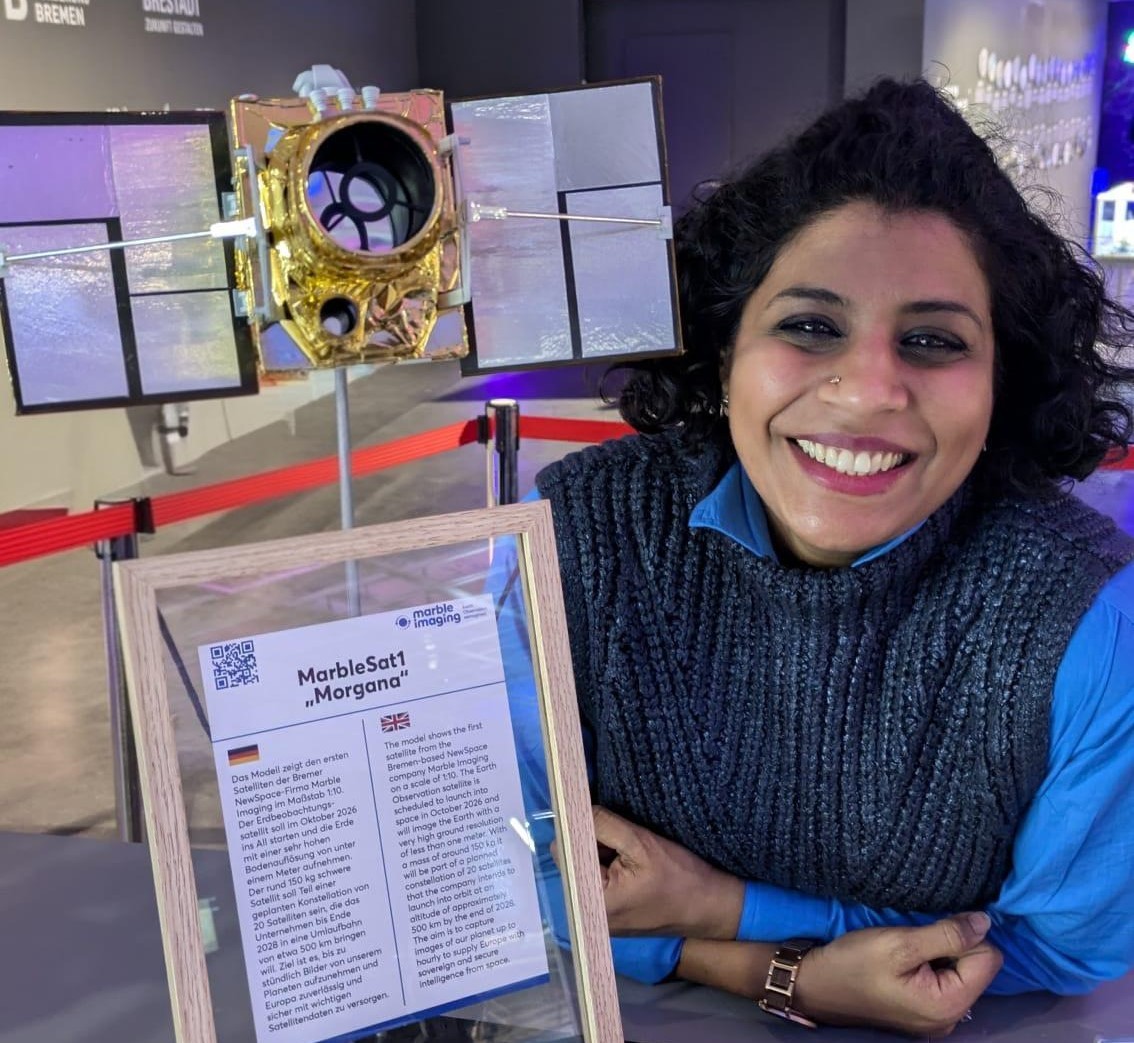
Dr. Gopika Suresh
March 27, 2026
There’s a particular kind of thrill in seeing the Earth from above, not as a postcard, but as proof. A grayscale radar scan. A coastline sharpened into data. Antarctica rendered in hard contrast, appearing on a screen while you’re sitting at a desk in Munich.
That was the moment Dr. Gopika Suresh fell for remote sensing - and it’s the same obsession now powering Marble Imaging, one of Robin Capital's portfolio companies. Gopika cofounded the European earth observation company to tackle a growing problem: Europe's data gap. Join us as we talk about everything that led her here.
About Dr. Gopika Suresh
Dr. Gopika Suresh is a co-founder of Marble Imaging, a European earth observation company building high resolution satellite imagery and analytics for security, climate, and monitoring use cases. With more than 16 years in Germany’s space and geospatial ecosystem across academia, government, and industry, she brings deep technical and strategic experience to Marble Imaging’s mission.
About Marble Imaging
Marble Imaging is building Europe’s first very-high-resolution satellite constellation for daily monitoring of our planet. Together with leading European partners, the team is combining state-of-the-art space and ground technology, advanced multispectral payloads, new propulsion and laser downlink systems, onboard processing, and AI-powered analytics, to turn Earth observation data into fast, actionable insight. Their mission is to support better decision-making across food security, sustainable energy transitions, climate resilience, infrastructure and mobility, and global security.
The long way to space
Gopika’s route into satellites wasn’t a straight line. It began with a childhood dream of becoming an astronaut, detoured through engineering, and then found its way back to space when satellite communications stopped feeling abstract and started feeling possible.
She grew up in India, but Germany entered her orbit early. As a teenager, she lived in Berlin while her father worked there as a diplomat, and she took her eleventh and twelfth grade classes there. When it came time to choose where to pursue advanced studies in space-related fields, familiarity and feasibility mattered just as much as ambition.
“In my third or fourth semester of studying engineering, I had a lecture in satellite communication, and I thought, okay. Satellites are a way for me to get back to space.”
In Munich, she trained across the full satellite ecosystem: mission design, systems engineering, launch logic, and what happens once a satellite is already in orbit. The technical foundation gave her a strong start, but it was the data that captivated her.
“It was always my dream to study and work in space somehow. The data is what fascinates me because you can see so much. You’re looking at the Earth from space, and it gives you context. It gives you this bigger picture.”
Small world, big problem
Space may be vast, but the space community in Germany is not. As Gopika moved through academia, government, and industry, the same names and institutions kept intersecting. Marble Imaging came together through that closeness, but it was catalyzed by something much larger than proximity.
After years working in academia and with government institutions, a global shock made the absence of European-controlled data impossible to ignore. “While working for the government, there was this moment during the Ukraine war when we realized the impact of European data - or the lack of it,” she recalls.
Marble Imaging’s founding moment was disarmingly simple. A reunion with a longtime contact, cofounder and CEO, Robert Hook. They shared a coffee and both came to the realization that the timing was no longer theoretical. “Alex (CMO) is a friend of Robert's, and Raul, the fourth cofounder, also worked with me. That's how we came together. It's now been sixteen years for all of us working in the sector in Germany.”
“We started Marble Imaging to come up with a solution to the problem of the lack of European data.”
Why high resolution matters, and why now
Commercial satellite imagery has existed for decades, but it was often treated as supplementary. Public datasets from Europe and the US carried much of the analytical load - until they no longer could.
As geopolitical pressure intensified, the need for sharper, more frequent, more actionable imagery became unavoidable. Conflict monitoring is only one part of the story. Refugee movement, infrastructure disruption, climate-driven risk, and environmental damage all converged around the same requirement, visibility.
Suddenly, “we needed to have eyes on the ground, or eyes from space, and there was a lack of this,” Gopika explains. Having worked on climate applications for years, she is candid about what finally forced the broader market to pay attention.
“Climate change has been a pressing topic for a long time. It’s affecting all of us, but the impact isn’t always felt as destruction. The need for very high resolution data really came when destruction from war made the impact impossible to ignore.”
Building insights, not just imagery
Marble Imaging’s approach begins with focus. Rather than offering endless horizontal tools, the team concentrates on verticals where high resolution imagery can produce repeatable, decision-grade signals over time.
“Instead of having a billion different horizontal applications, we’re targeting three verticals: activity, change detection, and monitoring,” she says.
“The good thing is that everything is built in house, we've got a really strong team of geospatial scientists and machine learning/AI engineers building our AI powered tools,” she adds. “And we can have the algorithms tuned to any kind of Earth Observation data. We like to call it sensor agnostic, because it does not depend on one kind of sensor, and resolution agnostic, because our tools work with very high resolution images as well as medium resolution images.”
These applications draw from both public datasets, including Copernicus and USGS, and commercial very/high-resolution multispectral imagery. Internally generated training data allows Marble ’s models to adapt across sensors and resolutions as new data sources come online, rather than being locked into a single feed or format.
Resolution, she notes, is not an abstract metric. It directly determines what is visible and what remains invisible.
“When you’re working with medium resolution images that are freely available, you’re not able to see the finer details.”
The satellite roadmap, washing-machine-sized to planet-scale
Marble Imaging currently combines public and commercial data sources. The next phase is about ownership - control and independence. “With one Marble satellite, we’re not going to be able to get daily insights or daily images of the entire planet because our satellite is the size of a washing-machine,” she explains.
Orbital physics sets the pace. Coverage requires scale, and scale requires patience. “We need a constellation of 20 satellites for daily coverage over the entire planet and hourly revisits over Europe. If we need hourly revisits over the entire planet, we need 200 satellites,” she adds. “Our first Marble satellite will be launched later this year.”
The commercial logic follows naturally. Some customers want imagery. Others want answers, ships detected, vulnerable coastlines identified, access routes assessed, changes tracked over time. Control matters too. Owning the satellite means tasking becomes a capability, not a request. Having hourly revisits over Europe means that time critical events can be closely monitored, increasing community resilience and security.
“High quality and accessibility will be synonymous with Marble. We will provide imagery and data, but we also have our analytics to provide information to those who are looking for just that. All of this will be made accessible via our web platform and API”
Europe first
Marble Imaging is positioning itself as a European provider at a moment when sovereignty and strategic independence have moved to the center of policy and investment conversations. European partnerships are intentional, spanning sensor, platform, and technology development, even as launch realities remain complex.
When asked about their Europe-first strategy, Gopika says, “we will be the only European provider to offer something like this. We’re really fostering and strengthening European connections because we need this innovation and capability in Europe, for Europe,”. With the launch of the first satellite in 2026 and 4 satellites thereafter in 2027, Marble aims to be the first European company to provide high frequency, very high resolution imagery and insights from its own constellation of Marble satellites.
At the same time, she acknowledges that the pace of the sector is unforgiving.
“Ten years ago, 25- or 50-meter resolution was fine. Today, 50 centimeters or better is a requirement.”
Staying ahead of the competition
Staying competitive means focusing on modular design, continuous research, and faster processing, including onboard computation for time-critical insights.
“Think of our satellites as the final LEGO model consisting of various components provided by our suppliers and partners but operated by us and where we provide high quality data and analytics. Already with our first satellite, we are combining innovative spectral bands to provide more spectral information to our users. A laser terminal on board our first satellite will ensure larger and faster data downlinks.”
“To stay innovative and competitive, we conduct extensive research about what is currently on the market not just regarding space optics and hardware but also sensor fusion and edge computing.”
What feels hard right now
In deep tech, the difficulty usually comes down to resources. Not because the problems are unsolvable, but because they are capital-intensive and time bound. “When we’re talking about satellites, it’s very expensive. It’s a longer-term investment, and that’s difficult for people to grasp,” Gopika clarifies.
Beyond hardware, processing remains a quieter challenge. Legacy infrastructure relies on fragmented servers. Cloud solutions help, but they introduce real costs and complexities of their own.
“Historically, it’s been done with servers in different rooms. A cloud solution is expensive and needs to be hosted somewhere.”
A team culture built on trust
Marble Imaging is a 20-person team built on long-standing relationships. Gopika describes the culture as familial, grounded in trust, flexibility, and shared responsibility. Having co-founded Marble Imaging while pregnant with her second child, she says it was all made possible by a support system she trusted.
She describes the team culture as “young, but with a trust factor.” That trust extends to how the company approaches equity and leadership. Diversity is treated as structure, not branding.
“We are very conscious about gender equity, representation and pay equity. The only reason I could co-found this company while being pregnant and having another full-time job is because I knew I would have the support of the rest of the cofounders.”
Quickfire round
A tool you can’t live without:
“WhatsApp. Especially with kids - those voice notes save everything.”
A founder you admire:
“Doctor Karen Joyce from GeoNadir. She’s an inspirational woman.”
Recharge ritual?
“Squishing the cheeks of my little ones and getting big hugs.”
Advice that has stuck with me:
“You cannot change the direction of the wind, but you can adjust your sails.”
Marble Imaging is hiring!
Marble Imaging is actively looking for passionate people to join the team. “We’re always looking for people who want to work in a dynamic, young, familiar environment,” says Gopika. So, get in touch with her via LinkedIn or check out Marble Imaging's job page.