

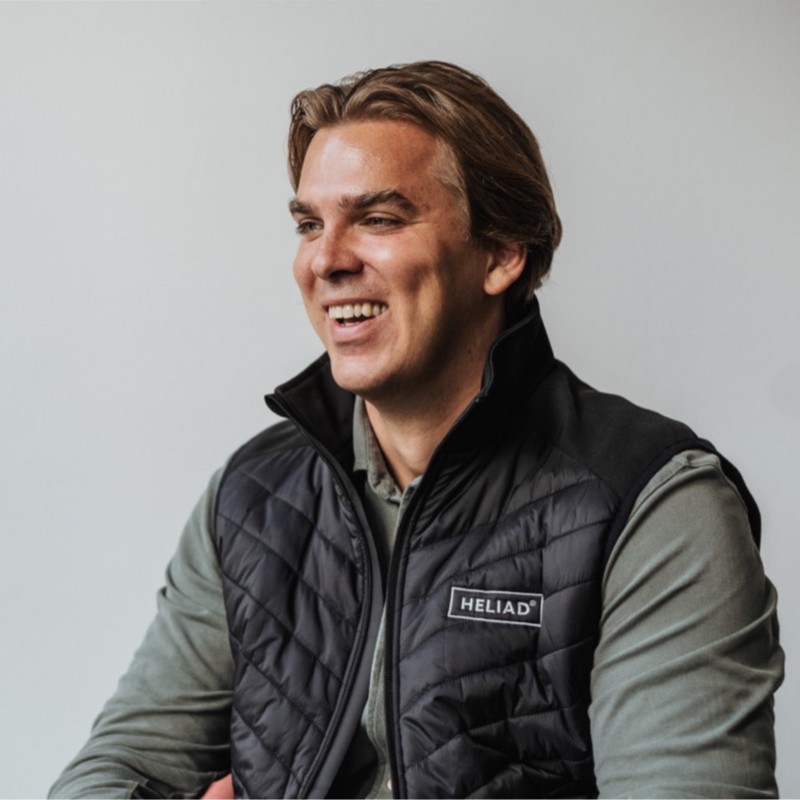
Falk Schäfers
May 15, 2026
Many Venture Capital funds invest in the same kinds of companies. They look for companies that are asset-light and software-driven, promising exponential growth without requiring large amounts of capital. But some of the most important industries shaping the next decade, energy, robotics, infrastructure, and advanced manufacturing, don’t fit that model. They are slower to build, more operationally complex, and often require financing structures that many venture firms prefer to avoid.
Falk Schäfers believes that this is exactly where the opportunity lies. As CEO of Heliad AG, he works with founders building businesses that sit at the intersection of software, physical systems, and capital-intensive infrastructure.
Join us today as he explains how Heliad’s balance-sheet model allows the firm to think differently about time horizons, why capital-heavy startups are often underestimated, and where he sees Europe’s next generation of breakout companies emerging.
About Falk Schäfers
Falk Schäfers is the CEO at Heliad, the Frankfurt-listed investment company backing startups across Europe. Before joining Heliad in 2021, Schäfers spent more than six years at Berenberg, the investment bank, where he helped build the firm’s corporate finance business in the DACH region and advised on more than 60 capital markets and M&A transactions. During that time, he worked on several prominent technology IPOs from the Rocket Internet era, including HelloFresh and Delivery Hero. At Heliad, he now focuses on identifying and supporting high-growth technology companies while helping founders shape their equity story, navigate financing rounds, and prepare for potential exits through M&A or the public markets.
About Heliad AG
Heliad AG invests in market-leading, fast-growing technology companies with the target of initiating the next phase of growth. As a publicly listed company and through its strong team and strategic partners, Heliad supports companies pre-, at-, and post-IPO and acts as a gateway to public equity capital markets. An evergreen structure allows Heliad to operate independently of the usual fund lifecycles. It provides shareholders with unique access to pre-IPO market returns, without restrictions on investment size or term commitment.
Built differently
Heliad's structure is one of the first things Falk highlights when explaining how the firm works with founders. Unlike traditional venture capital firms, Heliad does not operate with closed-end funds that must return capital within a specific timeframe. “We are stock exchange listed, and we are investing straight from our balance sheet,” he explains.
This difference changes the dynamics of the team's approach to investments and the length of time the firm can remain involved with a company. While many venture funds eventually face pressure to exit investments once a fund matures, Heliad has more flexibility in determining when the right moment for an exit actually arrives. Instead, Falk states that “we can stay with the company indefinitely.”
This flexibility matters especially at this moment. Not only are many startups remaining private for longer than in the past, but more and more companies are emerging with longer runways. In this context, investors who are more patient often become valuable partners for founders navigating longer growth journeys.
Falk is also eager to point out that returns are, of course, still important. But the ability to support companies without being tied to rigid timelines creates room for decisions that better align with the business's current trajectory. Even in cases when a company ultimately gets listed, “we typically stay invested and aim to be a long-term partner,” he adds.
"We don't have the typical fundraising periods. And, for founders, we don't have the same fund life cycles, so we don’t have the pressure for them to exit after year seven."
“Start early, then back the winners hard”
Falk is keen to emphasise that Heliad is multistage and “we typically start very, very early, which most people might not know.”
Through its Collective Ventures strategy, Heliad typically writes its first check between €500,000 and €2 million. These early investments usually occur at the pre-seed through Series A stages and are often made alongside a network of experienced entrepreneurs, operators, and business owners.
This early-stage strategy is supported by a relatively tight circle of around fifty investors, including former founders and senior figures from the German Mittelstand. Their experience and networks often provide additional support to companies at the earliest stages.
This strategy does not stop at early investment. Heliad also allocates significant capital to increase its positions in companies demonstrating strong traction. Follow-on investments can reach up to around €10 million in later rounds, allowing Heliad to remain a meaningful partner as companies grow.
For the Heliad team, the aim is simple: discover promising companies early and continue backing them as they scale. “We aim to invest double-digit million amounts to double down on the winners from our early-stage portfolio,” Falk explains.
“We typically aim for up to €10 million to double down.”
Software alone is not enough
When discussing investment theses, Falk avoids presenting a single rigid framework. Markets evolve quickly, and the most interesting opportunities often appear in places that traditional venture models overlook.
One guiding idea at Heliad is that the current venture ecosystem has become too focused on purely software-driven businesses. “A lot of value is created where software meets the physical world,” he relays.
These companies tend to have more capital-intensive business models and therefore “need to be steered in a different way than simple software businesses,” he explains. But that complexity can also create stronger barriers to entry and more defensible businesses.
For Heliad, this intersection between digital capabilities and the physical world is where some of the most compelling opportunities lie.
"One thesis we had from the beginning was that software is not enough. Software is worth it one hundred per cent, but lots of value is created where software meets the physical world."
Backing the companies many investors talk themselves out of
Capital-intensive business models can make some venture investors uncomfortable. In Falk’s eyes, “a lot of businesses can create a huge amount of volume but haven’t been financed in the past because many venture capital investors have been scared away by the fact that the business is asset-heavy.”
Heliad takes a different approach by remaining open to businesses that require more complex financial structures, such as those in robotics, mobility, energy infrastructure, or other sectors where capital intensity is unavoidable.
While these models may appear more complicated at first glance, they can also create strong long-term advantages as they scale. Fewer investors are willing to navigate the complexity, leaving more room for companies that execute successfully.
“If you go into a meeting with a founder and say from the beginning that you're not into lending, then you lose out on many opportunities.”
Europe vs the US
Comparisons between the European and American venture ecosystems often focus on the differences in capital availability and exit markets. While the United States remains more mature in many respects, Falk remains optimistic about Europe's trajectory.
Europe's startup ecosystem continues to develop as more experienced founders emerge and successful companies generate the next generation of operators and investors. “The venture ecosystem is not as old as it is in the US, so it just takes more time to get things off the ground.”
At the same time, the increasing presence of American venture firms in European rounds reflects growing international interest in the region's startups. Top Series A and Series B deals now frequently include US investors seeking exposure to European innovation.
"I'm rather bullish on the European environment. Building a strong ecosystem takes time."
Supporting founders beyond capital
For Falk, he and his team must provide value beyond capital, and he describes their role in practical terms: “We want to be the mental sparring partner over a longer period of time.”
He is keen to highlight two areas in particular where they add value to their portfolio companies.
The first is capital markets expertise. Many startups encounter financing challenges earlier than expected, especially when their business models involve lending, leasing, or embedded financial services.
The second area is helping companies navigate relationships with government institutions. Even startups that initially target private markets often find themselves interacting with regulators or public-sector organizations as they grow. This part has become so important that “we actually built a dedicated desk for it. It’s B2G, business to government,” he says.
"We cannot build the a16z platform with hundreds of people helping with every aspect of the business, but we also don't want to be a small investor who only provides capital and occasional introductions. We try to position ourselves somewhere in the middle."
The next frontier is compute
Looking further ahead, Falk points to computing power as one of the key drivers of future innovation. The rapid progress seen in AI has shown how powerful new capabilities can emerge when more computational resources are applied to complex problems.
For him, “the future is just about strong compute.” Rather than simply improving existing tools, these advances could make previously unsolvable problems solvable.
For now, that story is dominated by GPUs and the AI boom they have enabled. But he is already looking further ahead. He points to the emergence of quantum processing units, or QPUs, as a development that could radically increase efficiency and expand what can be solved through computation.
If that leap happens, the implications could be profound, not only for AI, but for science, industry, and whole new startup categories that don’t exist yet.
“Today you can throw more computers at a problem, and the more computers you throw at it, the more likely you are to solve it.”
Quick Fire Round
A tool you can’t live without?
“Super boring answer. It's definitely WhatsApp.”
How do you recharge?
"If I’m proactively committing to it, then spending time with my family. It's super grounding. Also going out with some friends to catch some music and enjoy a few drinks on the weekend."
Advice that stuck:
“Always be agile.”
Founder or start-up that you admire:
“Bernd Förtsch is a super strong entrepreneur. He founded flatexDEGIRO back in 1999, when very few people believed in that kind of business. Today, it’s a listed neobroker in Germany worth billions. What I really admire is how he handled the tough periods. The stock went from around €30 during the COVID era to about €5, and much of his own wealth was tied up in the company. But he stayed calm, took action, and kept building. Now it’s back at around €40.”
What does the future look like?
For Falk, the venture landscape is entering a phase in which the easy categories of the past are disappearing. As a result, the next generation of startups reshaping our industries will not be purely software, purely hardware, or neatly aligned with the models venture capital became comfortable funding over the past decade.
In 2026, Heliad is doubling down on Robotics, AI, Industrial Automation, Defense, GovTech, and more. If you're curious about what they’re building and what they’re looking for, reach out to Falk on LinkedIn.