


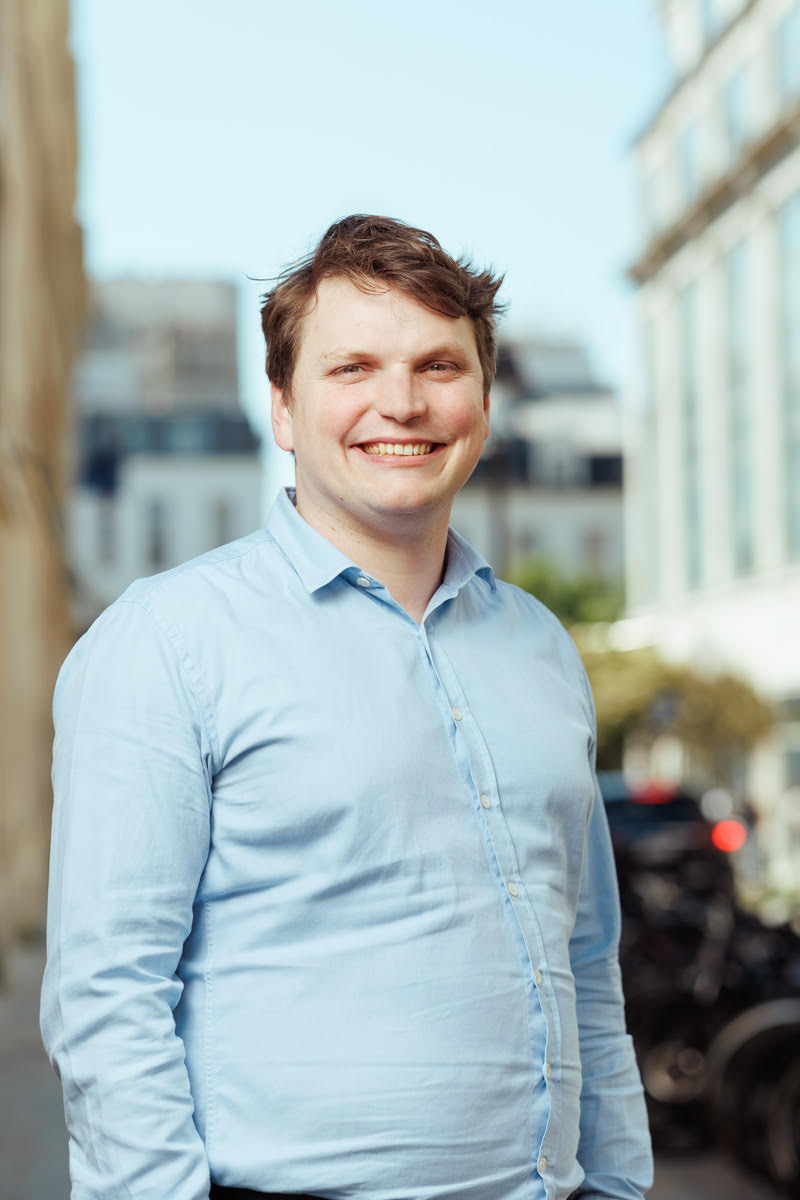
Hugo Lochmann
December 10, 2025
Construction is the largest industry in Europe, yet one of the least digitized. After nearly a decade working in the sector, Hugo Lochmann saw firsthand how broken the operational systems were - fragmented, error-prone, and outdated.
In 2024, he co-founded Grafit to build the tools he wished he’d had as a business unit manager. Now, backed by LocalGlobe and Robin Capital, Hugo and his team are creating the digital stack construction companies have been waiting for.
About Hugo Lochmann
Hugo Lochmann is the founder and president of Grafit.fr. Before founding Grafit, he was the Chef d’Enterprise at SDEL Rail and a Senior Associate at Boston Consulting Group. He studied at École Polytechnique and Mines Paris. Under his leadership, Grafit is developing software solutions for the construction and building industry.
About Grafit
Grafit is a construction operations platform that replaces the industry's outdated spreadsheets with modular, scalable software. Built for SMBs on the ground, Grafit gives construction teams a clearer, more accurate way to manage performance and resources—without the overhead of custom tooling. Companies save time and reduce waste, while business unit leaders get real-time visibility into operations. At the same time, Grafit helps standardize workflows across fragmented organizations, creating a win-win for teams and leadership alike.
"Everyone was building their own broken tools. We're building one that actually works."
A massive industry, stuck in Excel
Across Europe, construction companies continue to rely on spreadsheets. For project managers, business unit leaders, and finance teams alike, tools like Excel remain the default - despite being difficult to scale, impossible to standardize, and prone to costly mistakes.
“In the same company, every project manager builds their own tool, most of them are broken, and no one can consolidate anything.”
It’s not just inefficient - it’s expensive. Hugo estimates that 20% of activity in construction today is waste. “That’s material, time, resources - gone. And it’s starting to matter more, because the industry is under pressure. Clients, regulators, and new contracting models are demanding more transparency and better results.”
Meanwhile, the user experience hasn’t evolved. “People are stuck doing low-value, repetitive work,” he says. “It’s one of the reasons young people don’t want to enter the sector. They don’t feel empowered or valued.” Grafit aims to change that by making the day-to-day smarter, smoother, and more meaningful -while saving companies real money in the process.
“Construction is the biggest industry in Europe - and it’s still in the prehistoric age of digitalization.”
A problem Hugo knew too well
This isn’t a founder building from the outside in. Hugo spent the better part of a decade in construction, managing large teams and complex operations for companies like SNCF. A graduate of Polytechnique, he tried to bring efficiency through engineering - building perfect spreadsheets, writing macros, structuring processes. But even the most elegant Excel model couldn’t be shared across teams. “It just doesn’t scale,” he says.
When he became a business unit manager, the problem only got louder. Everyone around him had the same complaints. Tools were inconsistent. Errors were frequent. And leadership couldn’t get a clear picture of what was happening on the ground. “It was impossible to manage performance. So I thought: if I’m going to build better tooling for my own company, why not build it for the whole industry?”
From France, with a European mindset
Hugo co-founded Grafit in early 2024 with a close friend from school who was consulting in product. The two aligned immediately on the problem and the opportunity. “One night I discovered Procore,” Hugo recalls, referencing the American construction tech company that generated over $1 billion in revenue last year. “I texted Victor and said - we’re not building a tool for my team. We’re building Grafit.”
The duo brought on a CTO through their rugby alumni network, and recruited two founding engineers after interviewing 60 candidates. A founding associate soon followed. “I emailed hundreds of people to find her,” Hugo says. “I knew exactly what we needed - and when I saw her profile, I knew.”
The Grafit team is based in France, with a freelancer in London and plans to scale across Europe. That cross-border ambition was core to their fundraising strategy. “We wanted investors with strong networks in the three biggest construction markets - France, Germany, and the UK.”
LocalGlobe led the €3M round, with participation from Kima Ventures, Motier Ventures, and Robin Capital. “Robin came in late, actually,” Hugo says. “The round was full, but we made space. We just clicked.”
“We’re not building a tool for my old company. We’re building the future of construction.”
Raising money, and raising the bar
Hugo describes the fundraising process as intense - but energizing. “I’ve been in construction for years, but this was a crash course in SaaS. The funds had a deep understanding of software, and I brought the market expertise. We learned from each other.”
He was quick to call out Robin Capital as more than just a check. “We were already closing the round when we met Robin,” he recalls. “But the energy just clicked. We had a 30-minute call and knew we had to make space for him.”
The goal now is to turn that early backing into a market-defining product. Grafit is starting with SMBs - teams doing the actual building, usually with revenues between €4M and €15M. “Even the big construction firms are structured around smaller units,” Hugo explains. “These are the people closest to the pain. And they’re the ones who are excited to try something new.”
“If you're going to win this race, you need a European footprint from day one.”
What's next for Grafit?
In this first phase, the team is focused on replacing the broken, unscalable systems that project managers rely on every day—manual spreadsheets, disconnected templates, and ad hoc workflows that make it nearly impossible to track performance across projects. Grafit's early product gives construction teams a structured, intuitive interface that mirrors how they already work—without the friction of legacy software or generic ERPs.
But the long-term ambition runs deeper. Hugo and his co-founders want to build the modern operational stack for construction across Europe: modular enough to adapt to different trades and team structures, powerful enough to standardize processes across regions, and simple enough for non-digital-native users to adopt instantly. “We're building for the people actually doing the work,” Hugo says. “It has to feel obvious from day one.”
Quick Fire Round
Tool you can’t live without?
“ChatGPT.”
Founder or startup you admire?
“A friend of mine, Guillaume. He’s building in a brutal space—and somehow making it work.”
Recharge ritual?
“Long walks talking with my wife.”
Best advice you’ve ever received?
“Choose the next job based on where you’ll have the most fun for the next three years. That’s where you’ll learn the most.”
Grafit is growing fast and shaping the future of construction tech! Join the team and be part of the journey — explore open roles at grafit.fr/recrutement