

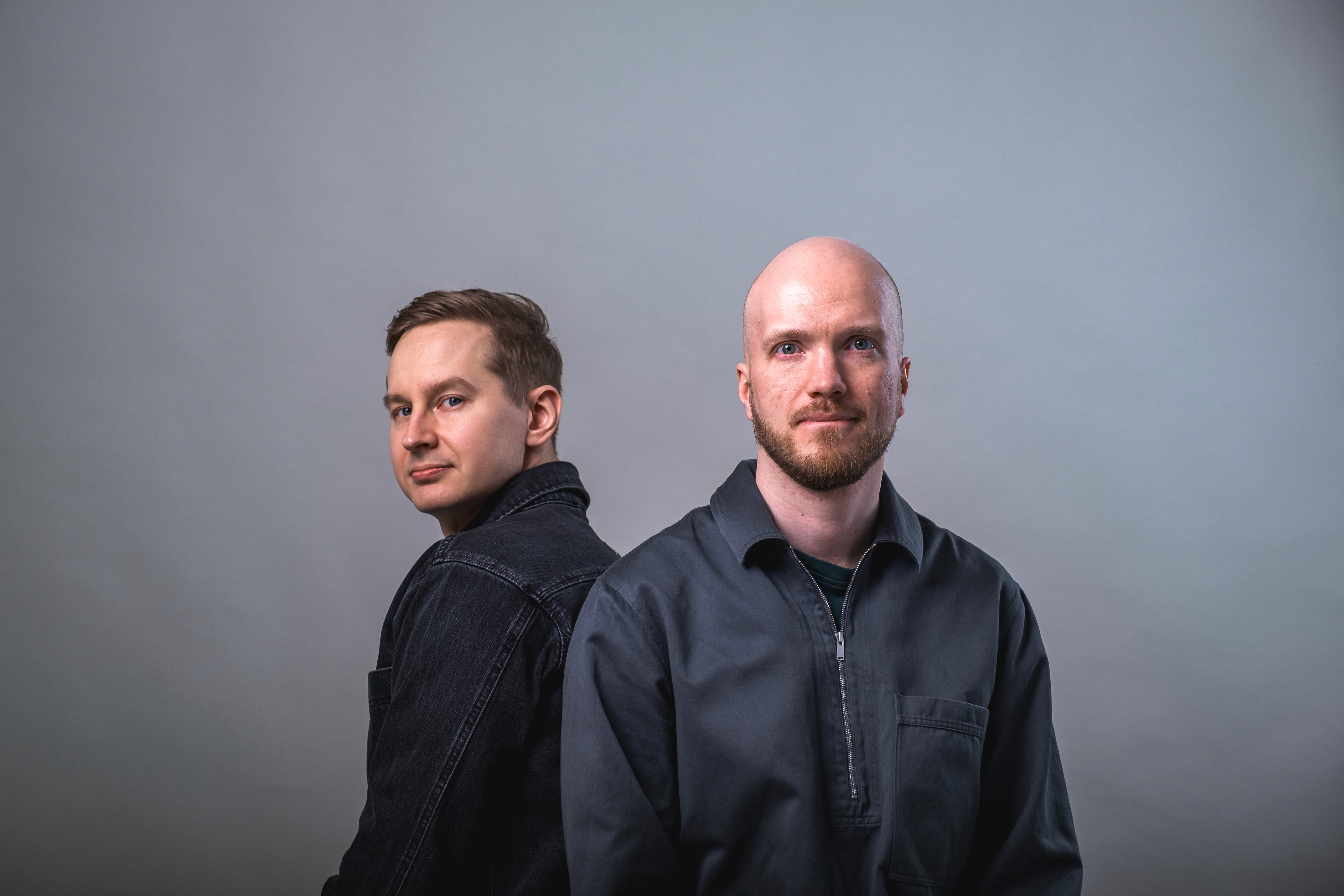
Jesse Miettinen and Mikko Kuusisto
June 10, 2026
Inside a heavy industrial plant, engineers still spend hours staring at condition monitoring data, trying to catch the faint signals of a machine in distress. It’s painstaking work, and even with years of experience, important warnings can slip through. A single critical machine failure during an eight-hour shift can cost an industrial plant close to €1 million in lost output.
Rotomate believes there’s a better way.
The Finnish startup, co-founded by Jesse Miettinen and Mikko Kuusisto, is building an AI colleague that relieves engineers from the stress of a faint signal slipping through. Their software automates the painstaking work by examining every single signal with the trained eye of an experienced engineer. Now, the company has raised €2.1 million in pre-seed funding to scale that vision across Europe’s industrial sector.
The round was led by industrial technology investor Kvanted, with participation from Robin Capital, Angel Invest, Accel through its scout program, and Business Finland through an AI development grant.
I sat down with the two founders to talk about their vision for industrial AI, the shift from alerts to decisions, and their ultimate goal of making humans faster, sharper, and “superhuman.”
About Rotomate
Rotomate builds AI colleagues for industrial engineers, starting with condition monitoring. By mirroring the way experts work and think, the software delivers explainable diagnoses and maintenance recommendations in real time—the result: continuous insight across every machine, a live action plan, and fewer production disruptions.
The long-term vision is a reliability partner across all streams of machine data. In a sector often framed as humans versus machines, Rotomate is betting on partnership. Engineers and AI, working side by side.
Today, Rotomate monitors more than €3 billion worth of annual production across four industrial sites in Finland and Poland, with early customers including Metsä Group, SSAB, and Aurubis.
From Research to Real-World Impact
Rotomate’s story began in vibration analysis, the workhorse of machine diagnostics. For decades, engineers have relied on it to catch a worn bearing or a failing gearbox. But the tools they use are far from modern. Engineers still sift through dense plots of data on screens, piecing together meaning from lines and peaks that often look more like abstract art than science.
Rotomate’s early attempts to automate this with deep learning promised much and delivered little. Models worked in narrow scenarios and spat out results no one could explain. Customers wanted explanations, not a system they could not trust.
The requirement for explanations was the opportunity. The timing was right for a paradigm shift; agentic AI provided the technology to mirror how engineers actually work - and explain its reasoning the way a colleague would. Time for a perfect pivot!
“Hundreds of millions in R&D had gone into machine learning models producing black-box alerts (at best). The reliability bottleneck was still the human trying to interpret them. What customers needed was explanations,” – Mikko Kuusisto.
“It did not take us many months to realize that we could not only build explanations, but even better, a maintenance recommendation system with modern agentic AI and reasoning capabilities. – Jesse Miettinen.
The virtual colleague
The result is a product that feels less like software and more like a teammate.
Rotomate’s AI colleague processes the plant’s condition data, maintenance history, and operational context, and communicates findings the way a human teammate would.
“Essentially, we just make a virtual colleague for the engineer currently analyzing the data,” Mikko explains. Instead of humans spending half an hour per anomaly, the AI can work through cases in minutes. And the process is familiar.
“It’s technically the same, but instead of humans looking at the visualizations, now AI is looking at those data points,” Jesse says.
Where conventional monitoring systems stop at alerts, Rotomate goes further. The software explains what is causing the issue, what action is recommended, and why. “Most existing condition monitoring software stops at alerts. Experts go further. Software should too,” says Jesse Miettinen.
Currently, condition monitoring software can generate hundreds of alerts every day, many of which never get reviewed at the factory. There’s even a label for this phenomenon: alert fatigue.
“Where engineers used to chase ambiguous alerts, our software says: ‘I noticed a problem in a gearbox. Here is the proof. Visual inspection recommended - want me to write a maintenance ticket?” Jesse continues.
The company says its platform can reduce manual monitoring time by up to 83%, making expert-level analysis available across every machine in a plant.
“We’re not only making it possible to process all these ambiguous alerts - we’re building a world without them, ” – Mikko Kuusisto.
A market hiding in plain sight
Predictive maintenance isn’t new, and plenty of companies are already in the space.
Most, however, offer little more than alerts triggered by anomalies. Rotomate pushes further, delivering not just warnings but reasoning and recommendations.
“So far, most predictive maintenance tools are detection systems. The job is to fix the machines that need fixing, and it only starts upon detection. We’re building a reasoning system,” says Mikko.
The target market is clear: large industrial facilities with annual output exceeding €500 million, particularly in the pulp and paper, steel, and copper sectors. These are the plants where downtime costs millions, where condition-monitoring systems are already in place, and where plugging Rotomate into existing data pipelines is straightforward.
Rotomate’s commercial pipeline is already anchored across Northern and Western Europe, including Finland, Sweden, Germany, the Netherlands, and Poland.
Humans first
This positioning also defines how Rotomate talks about the future. While headlines tout visions of “dark factories” with no human operators, Jesse and Mikko are deliberately steering away from that narrative.
Rather than pushing full automation, they frame their AI as a partner.
“We’re not building zero-human factories, and we’re not here to replace jobs,” Mikko explains. “We'd rather make engineers superhuman. The future isn't humans versus AI — it's humans with AI versus humans without.”
“We are not here to replace humans, we are here to supercharge their tools,” – Jesse Miettinen.
That human-first approach is also what attracted investors.
“A decade ago, the promise was ‘big data’. What European factories actually got was years of machine data they don’t have the specialist capacity to act on, and the cost shows up as unplanned downtime and lost output,” says Eerik Paasikivi, General Partner at Kvanted.
“Rotomate solves that bottleneck head-on by scaling expert-level reasoning to every machine in the plant, not just the ones a reliability engineer has time to review. That is exactly the kind of applied AI the European industry needs right now. We’re proud to lead this round.”
Beyond monitoring
For Rotomate, condition monitoring was just the entry point. The company’s roadmap is to create a holistic AI colleague for reliability engineering. This system pulls from oil-particle counts, temperature and pressure data, production logs, service manuals, and maintenance histories.
“The virtual colleague is actually using the current enterprise asset management systems and condition monitoring systems,” Mikko says. “The AI colleague will not only help speed up the vibration analysis, but it will also write tickets, find spare parts, and report to the managers.”
The founders describe this as a transition from expert-driven reliability processes to scalable maintenance systems that deliver expert decisions continuously.
Fuel for growth
That philosophy is resonating. What started as two founders experimenting with agentic AI has grown rapidly into a company now operating across multiple industrial sites in Europe.
“We started 2025 with just the two of us founders, and now we are a team of ten,” Mikko says. “Growth is still the focus heading into 2026 — we're doubling down on sales and on product development with our customers.”
With the new funding, Rotomate plans to expand hiring across engineering, product, and commercial roles to support international growth.
For Mikko, scaling ambitious companies is familiar territory. Before founding Rotomate, he was an early employee at Swappie, helping scale the company from its first €1M in revenue to €220M. Jesse, meanwhile, pioneered AI research in condition monitoring at Aalto University before founding Rotomate.
Several other team members hold PhDs in mechanical engineering and industrial AI.
Robin’s network and enthusiasm were the two things that stood out. We could see his enthusiasm. He was able to connect us with super-relevant experts and other investors as well. He has a good heart, he’s driving full speed, and he can think for himself,” – Jesse Miettinen
Quick-fire round
How do you recharge?
Jesse: “Ice hockey.”
Founder or start-up that you admire:
Mikko: “Ilkka Paananen, founder of Supercell.”
Advice that stuck:
Mikko: “Just be open always for new opportunities. If you hold to that, then you will achieve many things in life.”
The journey has just begun
Rotomate’s journey is just beginning, but its vision is clear. By rethinking how reliability is achieved, Jesse and Mikko are setting the stage for a future in which industrial teams can stay ahead of failures, minimize downtime, and unlock new levels of performance.
And now, with fresh funding and growing traction across Europe, the company is preparing to scale its AI colleague to more plants, more engineers, and eventually every stream of machine data on the factory floor.
Rotomate is hiring. If you’re a full-stack engineer eager to build AI colleagues that solve real-world problems, or a condition monitoring expert ready to bring your domain knowledge to a fast-moving startup, this is your chance to shape the future of reliability. Join the team making engineers superhuman.