


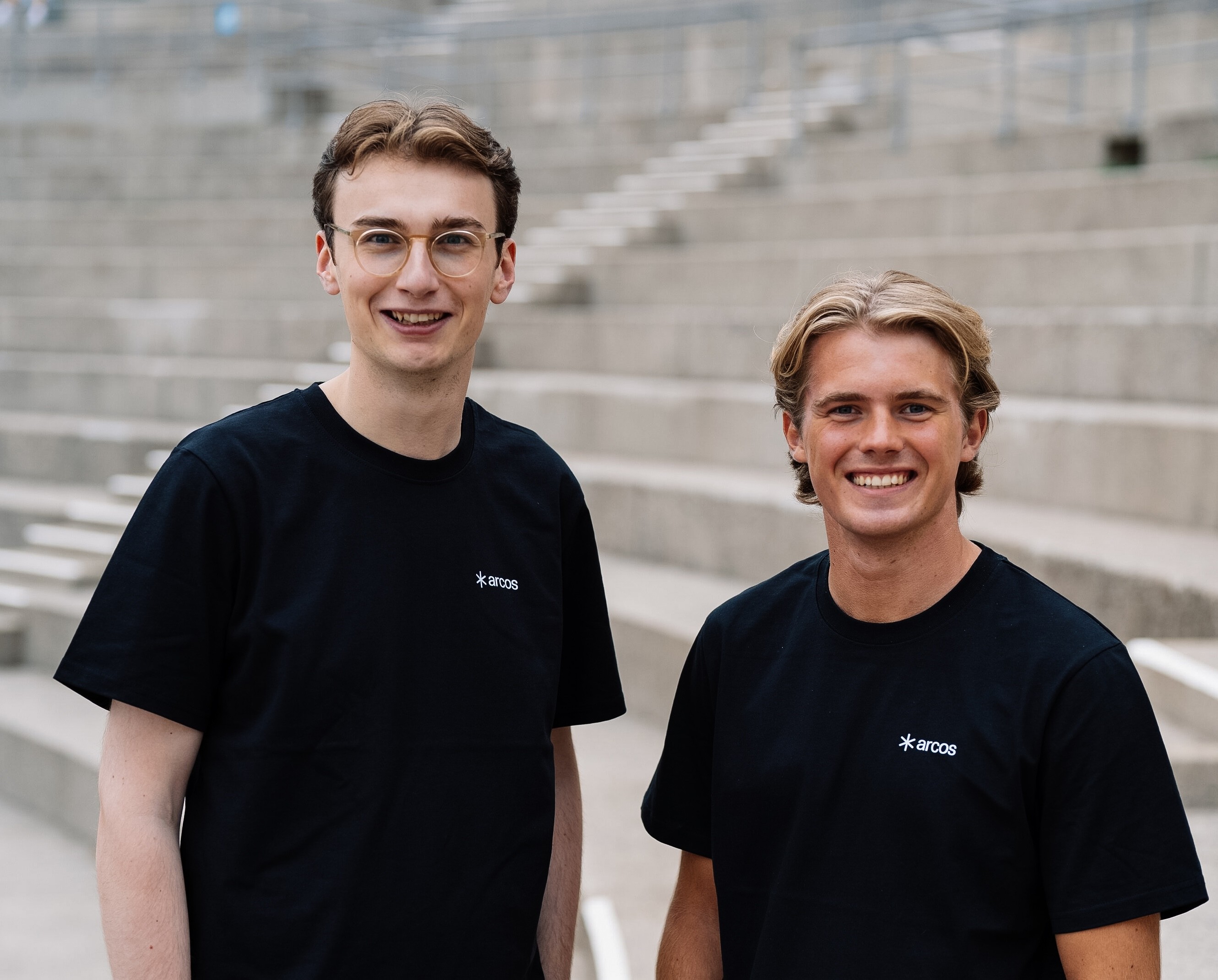
Louis Wübben
September 17, 2026
In the past few weeks, Germany has been reminded of how vulnerable its critical infrastructure is.
Suspected sabotage has targeted power infrastructure in places like Brandenburg and North Rhine-Westphalia. German officials also accused Russia of trying to carry out a drone attack at Leipzig/Halle Airport in August, though Moscow denies this.
These incidents have raised an important question: how can we protect the infrastructure modern society relies on?
Louis Wübben thinks the answer goes beyond traditional defense. Today, critical infrastructure, logistics sites, data centers, energy facilities, and businesses rely increasingly on connected cameras, sensors, and access systems. Still, he feels the civil security industry behind this technology has hardly changed in decades.
This is where Arcos sees its opportunity. Instead of adding more software, Louis and his co-founder, Moritz Steigerwald, are creating a new type of civil security provider. They combine technology with existing security infrastructure and experienced staff to make physical security faster, smarter, and more resilient.
Read on to discover why Louis sees civil security as one of Europe’s biggest overlooked opportunities, why Arcos chose to acquire instead of disrupt from the outside, and how making better use of existing data could change how threats are detected.
About Arcos
Arcos is building technology-led civil security infrastructure for Europe. The company combines proprietary software with security operations to monitor and protect businesses, critical infrastructure, and public-sector sites. Rather than replacing experienced security professionals, Arcos uses technology to automate repetitive processes, contextualize security data, and help operators focus their attention on the decisions that matter. Founded by Louis Wübben and Moritz Steigerwald, the company is also pursuing strategic acquisitions of established infrastructure, bringing existing expertise and customer relationships into a modern, tech-first security platform.
Finding the opportunity behind the alarms
Before founding the business, Louis worked in refinancing for Enpal, where he spent time looking at asset-backed financing models across different verticals.
While working this job, security began to catch his attention because of the physical infrastructure involved: cameras, motion detectors, alarm systems, and his realization that a lot of hardware can remain installed for years.
But what interested him even more was what happened behind the hardware.
Louis visited an alarm receiving center, one of the facilities where signals from security systems are monitored, and decisions are made when something unusual happens. Inside the center, he found a highly experienced workforce working with fragmented technology.
People worked in front of several screens and software systems, dealing with large numbers of alerts and doing repetitive administrative tasks by hand. One employee told him that in 11 years, she had only seen 18 real alarms.
To Louis, the mismatch was clear. Europe had advanced sensors producing lots of information, but the systems behind them still relied heavily on manual work.
At the same time, another trend was picking up speed. Service industries that once relied on manual labor were turning into software-driven markets. Louis and Moritz started to wonder if security could change in the same way.
“Inside the alarm receiving center, I thought, ‘okay, this can't be the backbone of European security.’”
Civil security’s moment
European investment in defense has accelerated dramatically as geopolitical instability has forced governments and businesses to reconsider security. But Louis argues that resilience can’t stop at military hardware or border defense.
Europe also needs to protect the infrastructure that keeps society functioning.
Data centers, electricity networks, logistics hubs, industrial sites, and public infrastructure are all potential targets. Meanwhile, threats are becoming more complex, increasingly combining both physical and digital threats.
Louis sees a large white space between the recent wave of defense innovation and the comparatively traditional civil security industry.
That gap is getting harder to ignore. For example, a fence might keep out a person, but it won’t stop a drone. As threats change, the systems for spotting and responding to them need to change too.
For Arcos, this is a chance to build infrastructure that addresses the risks Europe faces now, not just those from 20 years ago.
“We looked into civil security and thought, okay, this is a huge white space.”
Building security in Europe, for Europe
Arcos put a strong focus on sovereignty. Many of Europe’s biggest security companies are European, but the technology they use often comes from elsewhere. Hardware might be made in China, and software, detection models, or cloud services can rely on other countries.
Louis doesn’t think all foreign technology needs to be removed. Arcos also uses international tech providers when they need to. What matters more is where key security decisions are made and who controls the information.
This is particularly relevant in markets such as Germany, where attitudes toward privacy and surveillance are much more conservative than in other countries. A security model that is accepted in London may not suit Munich or Hamburg for example.
Therefore, Arcos wants to keep operational decision-making close to the infrastructure it protects. Its alarm receiving operations are based in the center of Germany and designed around the physical security required for critical systems, including backup power and highly secured facilities.
Customers are asking for this too. Louis says that for many German Mittelstand companies and public organizations, having European or German security infrastructure is now a clear requirement.
“If the signals are coming here, the decisions also have to be made here.”
Making more of the data we already have
Louis believes one of the security industry’s biggest untapped resources is the data that is already being generated.
A CCTV system, motion detector, or access-control system can produce enormous volumes of information. Yet in many cases, that information is ultimately reduced to a binary decision: genuine alarm or false alarm. What gets lost is context.
Imagine the same vehicle entering a company site every morning at the same time. A human will notice this pattern, but traditional systems don’t always keep or connect that information, so the same event can keep triggering alerts even though it’s completely normal. Arcos wants to change this by building context around individual sites and events.
Weather is another simple example. Bright sunlight hitting a camera at a certain angle can cause more false alarms, but by combining past alarm data with weather information, the system gets more context to understand what’s happening.
Louis believes that over time, connecting information from different sites, sensors, and outside data sources can make security systems smarter. Instead of just reacting to single signals, they can start to recognize patterns, which will lead to more informed decisions being made.
“There is no contextualization in our industry. There is no history-making.”
Automating the work, not the judgment
For all the talk of AI and automation, Louis is careful about where technology should take over.
He estimates that in an alarm receiving center, operators only spend about 10% of their time making security decisions.
They spend most of their time finding phone numbers, recording incidents, checking past information, and reaching out to the right people. These are the tasks Arcos wants technology to take over. The goal is to give experienced operators more time to focus on the parts of the job that require their expertise.
Software can gather the right information, show past events, and sort alarms in advance. Then, a person can decide if the situation is a real threat.
In this field, missing an alarm can have serious consequences, so this distinction matters. Efficiency matters, but reliability matters more.
“Technology is doing a job of pre-qualifying, and then human eyes are looking at the alarm and saying: this is a true alarm, this is a false alarm.”
Why Arcos decided to become the provider
Initially, Louis and Moritz thought about selling software to the existing security industry. They spent time in alarm receiving centers, talked to operators about their main problems, and built tools to help. Their ability to develop software quickly got people interested right away.
But selling it was another matter.
Louis compares replacing the main system of a 24/7 security operation to “open-heart surgery.” The current software might be old, but it works, and for operators in charge of critical systems, changing technology brings risk.
Arcos could have spent years trying to convince each provider to use its platform. Instead, the founders changed the model.
Rather than just selling software, Arcos acquired an existing alarm receiving center, added its technology, and became a security provider itself. This strategy also addresses another industry issue: succession.
Many of Germany’s independent security businesses were established in the 1990s, as new alarm and monitoring technologies became widespread. Today, an entire generation of owners is approaching retirement, often with profitable businesses, long-standing customer relationships, and no obvious successors.
Arcos sees a chance to keep that expertise alive while offering the technology and infrastructure needed for the future.
“If you really want to have the change management of building a new provider, the only way of doing this at the speed the market requires is to become the provider on your own.”
Moving fast in a market built around trust
Building fast is one thing, but building fast in the security industry is something else entirely. Arcos works in a field where cybersecurity and reliability are must-haves.
Louis says one of the company’s first goals was to earn the certifications insurers and customers expect from established providers.
The requirements go far beyond making sure the software works. Systems need backup infrastructure and failover processes to keep things running even if some services fail, which presents a unique challenge for Arcos: how to work quickly in a cautious industry?
For Louis, the answer lies in using AI in development. He says the idea of what makes a strong engineer is changing. Technical skills are still important, but so is knowing how to use generative tools to get more done without losing safety or quality.
The result isn’t about having fewer people. It’s about having a smaller team of highly skilled people who use technology to achieve much more.
“It's a mixture of having the right people and using AI.”
Becoming a new European security institution
Arcos is still just starting out, but Louis has big ambitions.
Right now, the main goal is to make Arcos a trusted name in a market where few brands are well known. That means gaining customers in business and government, building the core team, and keeping up with the certifications needed for critical environments.
The opportunities are wide-ranging. Big retail chains might manage hundreds of systems from many different providers. Data centers, energy infrastructure, and industrial sites all need more advanced protection. Public organizations face similar challenges.
Louis wants Arcos to connect all these separate systems.
The goal isn’t just to be seen as another security company. Within a year, Louis wants businesses considering infrastructure protection to know about Arcos. He also wants the company to show that its mix of technology, experienced staff, and smart acquisitions can do better than the current options.
In an industry where trust is key, real results matter more than hype.
“When you're thinking about security and securing your infrastructure, you should have heard about us.”
Quick-fire round
A tool you can’t live without?
“There are two. One is Granola because it’s always working. I don’t have to start it, and two days later, I’m happy that I can look up what I talked about in a call. And the second thing is my notes app on my phone because it’s my brain-dump where I type everything and clean it up once a week.”
How do you recharge?
“For me, it’s socializing. So it’s being together with family and friends and having some social time with them. Also, what matters most to me is having friends around me who aren't from this industry or scene. They don’t ask me, ‘How is this funding round looking?’ or ‘Who is your lead investor?’ They have completely different backgrounds.”
Founder or start-up that you admire:
“The most inspiring founder is someone I’ve worked with intensively over the last months, the founder of the company we are acquiring. He built a highly profitable company for 35 years and has a strong understanding of how the market is currently working. ”
“In terms of startups, I would say Quantum Systems. What I really liked was that they showed their beliefs transparently; it wasn't a PR move. They said, okay, we need a sovereign European provider building this technology and went ahead and made it.”
Advice that stuck:
“Authenticity is key in the long term. One of the first investors in this company told me from the beginning: "Of course, fundraising is about telling stories, but don’t tell fancy stories if you can’t back them up.”
Building the security infrastructure Europe needs
The physical and digital worlds are coming together. Critical infrastructure is getting more connected, and the threats we face are becoming more advanced. Yet, much of the industry that protects these assets still depends on outdated technology and manual processes.
Louis thinks Europe has a chance to rethink its infrastructure instead of just patching it up.
Arcos takes a practical approach. The company isn’t trying to replace every system, build every AI model, or replace experienced security professionals. Instead, it wants to connect what’s already there, automate what technology does best, and keep human judgment for the important moments.
Its acquisition strategy follows the same idea: bring together the trust, expertise, and customer relationships built over decades with technology designed for future challenges. They want to create a European security provider that becomes a key part of the infrastructure businesses, governments, and society rely on.
Get to know the company here and watch this space; we’re excited for their next moves.