


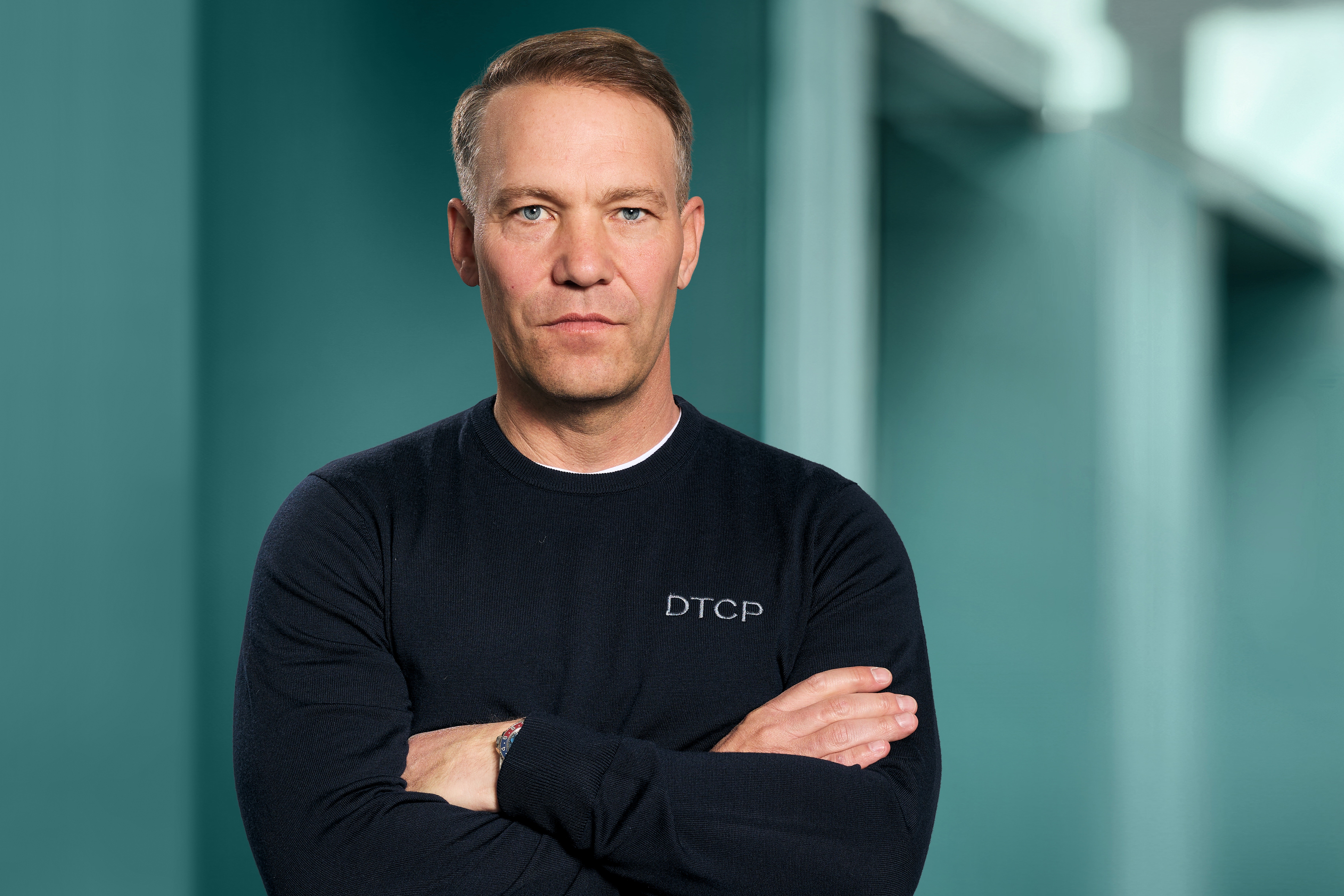
Thomas Preuss
June 11, 2026
When someone with years of experience in software, infrastructure, and digital transformation starts focusing on defence, it creates a real sense of urgency. This isn’t about slogans, but about systems: data centres, energy, logistics, communications, and computing. These are the industrial foundations that decide if a region can truly be self-reliant.
This shift happened for Thomas Preuss, and it’s the conviction behind DTCP’s new EUR 500m resilience and defence fund. After more than ten years of building DTCP into a specialist investment firm for digital transformation, Thomas is now asking a tougher question: what if Europe realizes too late that digital change never reached defence? Here’s how he got to this point and where he suggests we can go from here.
About Thomas Preuss
Thomas Preuss is Managing Partner at DTCP and a member of the investment committees and Chief Investment Officer of the DTCP Growth Group Funds. Since founding DTCP in 2015, Thomas has been responsible for the development and strategic direction of the growth equity investment business, establishing and refining the investment recommendations. He is charged with the management and performance responsibility of the overall portfolio. Thomas’ DTCP track record includes Quantum Systems, Dash0, Cognigy.AI (acquired by NICE), Neo4j, Aircall, LeanIX and Signavio (both acquired by SAP SE), Pipedrive (acquired by Vista Private Equity), Relayr (acquired by Munich RE. He has invested in these companies and serves as board member/observer. Thomas studied at the University of Hamburg and holds a master's degree in technical economics.
About DTCP
DTCP, Digital Transformation Capital Partners, is an investment management firm focused on sector-specialist growth equity and digital infrastructure strategies. Founded in 2015, the firm has raised more than $3 5 billion in funds AuM from corporate and institutional investors and invested in over 70 companies.
DTCP GROWTH invests in leading enterprise AI, cyber security and infrastructure software companies. DTCP DEFENCE invests in European defence and resilience technologies. DTCP INFRA invests in mobile access, fiber, and data center infrastructure. And DTCPs early-stage deep tech fund INCHARGE Capital Partners is a sector-specialist investment strategy for physical AI and new space.
DTCP has a dedicated value creation team supporting portfolio companies and corporate sponsors in creating measurable synergies. The driving force behind the firm’s strategies is the belief that the convergence of networks, devices and the internet is creating more wealth, disrupting more businesses, and unleashing more innovation than any force in the history of technology.
DTCP is headquartered in Hamburg with offices in Berlin, Frankfurt, San Francisco, Tel Aviv, Luxembourg, Valencia and London. To learn more about DTCP, please check www.dtcp.capital.
Defence has stopped feeling distant
Thomas came to defence not through theory, but through direct experience. Three years ago, DTCP invested in Quantum Systems, which exposed him to the reality of Europe’s digital defence infrastructure. He didn’t find just a small delay, but a major structural gap. “I learned that it is a real challenge to digitize defence because we haven’t done so,” he explains.
For someone with decades of experience investing in software, AI, cybersecurity, and infrastructure, the difference was clear. The private sector had already adopted the cloud, redesigned processes, and updated software, but defence was still using outdated systems. “We’re sitting on a 20–30-year infrastructure,” he says, “and everything we know about digital transformation has not happened yet in defence.”
The problem isn’t just that defence is behind, but that there’s little time left to catch up. In business, transformation took about ten years. In defence, Thomas thinks the same change now needs to happen much faster. “What took us ten years in the agile enterprise environment to digitally transform the IT stack, in defence, we may only have three to five years,” he says.
This shorter timeline changes everything. It makes transformation urgent, and that urgency brings responsibility. “This is not just a business opportunity,” he adds, “it’s something we have to do.”
For him, this realization is personal. “As a father of two, I know that we have to make our homework in Europe and Germany,” he says, seeing the challenge as a generational duty, not just a market trend.
Two years ago, before defence became widely investable or even widely discussable, the team decided to build a dedicated fund. It was not an obvious move. “Back then, this was not topical,” he recalls. “It was actually quite complicated to even talk about it.” But conviction outweighed consensus. “We didn’t start because everyone else was doing it,” he says. “We started because we felt we had to.”
“What took ten years in enterprise, defence now has three to five years to fix.”
DTCP DEFENCE and the broader defence stack
That decision ultimately became DTCP DEFENCE, DTCP’s resilience and defence fund. With a €500 million target and more than €300 350 million already secured ahead of its public launch, the fund represents a major step for the firm. But for Thomas, the size is only part of the story. What matters more is how the opportunity itself is defined. “We look at this in a very holistic way,” he says, pushing back against narrow definitions of defence.
Rather than focusing only on battlefield technologies, he sees defence as an entire system - one that begins far from the edge. Data centres, energy infrastructure, manufacturing, supply chains, logistics, space, communications and connectivity all sit alongside software, AI, cybersecurity and unmanned systems. “Really, the whole value chain from data centres towards military application and weapon systems,” he explains. In that sense, defence is not a vertical. It is a stack.
This way of thinking changes the conversation. Capability isn’t just about what’s used in conflict, but about everything that supports it. “If the infrastructure doesn’t work, nothing works,” Thomas says. “You cannot separate defence from the systems underneath it.” That’s why DTCP DEFENCE feels also more like a deep tech strategy focused on resilience and sovereignty than a traditional defence fund. “It is a deep tech strategy focusing on military and governmental,” he says. “And we believe this is where the biggest impact will be created.”
“Defence is not a vertical. It’s the entire stack beneath it.”
Europe’s sovereignty gap
For Thomas, defence is ultimately a question of sovereignty. He argues that Europe’s long neglect of defence investment has had consequences far beyond military readiness. “We neglected to invest in defence in the last 30 years,” he says, “and as a result we missed most of the big technology trends.” In his view, the connection between defence and innovation is not accidental. It is structural.
He points to Silicon Valley and Israel as examples of places shaped by defence-related R&D. “Internet, GPS, cloud computing, AI, all of this is a result of defence R&D,” he says. These technologies came from steady investment, talent development, and long-term planning. Europe, on the other hand, didn’t create the same cycle between defence spending and commercial innovation. “This is why Europe is where it is,” he says. “We missed most of the big tech trends these days.”
Still, he doesn’t see this only as a loss. He views the current moment as a late but real chance to change course. “With this wake-up call that we received here in Europe, we now have the chance to do it differently,” he says. This means investing for long-term capability, not just today’s problems. “If we use this rightfully, we can invest in fundamental R&D projects,” he explains, “and we will see the return of it in 10–15 years from now.”
This long-term perspective is key for him. He sees defence not as a reaction to crises, but as a way to build independence. “Not to fight against anyone specific,” he says, “but to invest in our sovereignty and defend our values.” He believes the bigger question is about identity and purpose. “We need to understand who we are and what role we want to play in this world.”
“We missed the flywheel between defence, innovation and global tech leadership.”
Europe’s AI problem starts with infrastructure
When Thomas discusses AI, he doesn’t start with models or trends. He starts with infrastructure. “We are lacking data centre and compute capabilities, and we have to actively invest,” he says. This view comes from DTCP’s experience in digital infrastructure, where the firm has worked for years on data centres, fibre, and networks.
From this perspective, Europe’s challenge is clear. AI isn’t just a software issue; it’s also a physical one. It relies on computing power, which depends on infrastructure. “If you don’t have the infrastructure, you cannot build the applications,” Thomas says. And infrastructure needs energy. “Data centres need a lot of energy,” he adds, highlighting one of Europe’s biggest constraints.
This creates a growing problem. Europe is behind in data centres, computing power, and energy. “We do have a lot to catch up,” he says, “when it comes to data centre infrastructure, energy infrastructure and compute.” Unlike software, these issues can’t be fixed quickly. They need investment, coordination, and long-term effort.
“There is not a simple answer to that,” he admits. But the way forward is clear. Progress will require cooperation between politicians, investors, entrepreneurs, and the wider ecosystem. “We all have to work on it together,” he says. “Otherwise, we will stay behind.”
“AI is not just a software race. It’s an infrastructure race.”
The long road to DTCP
Thomas didn’t take a typical path into investing. Before venture capital, he was busy building companies. “I started my first company when I was 17, still at school,” he says. Over the next twelve years, he started several projects, often running more than one at a time. Some worked, but many didn’t. “Most of them failed,” he says honestly, “because it’s not a smart thing to do to run three to five projects at the same time.”
But that time gave him something more valuable than early success: experience. “I never had a mentor, I never had someone who taught me anything,” he says. “I just did it.” This hands-on approach shaped how he views founders today, not as distant figures, but as people dealing with uncertainty in real time.
Eventually, he realized that instinct wasn’t enough. “I needed to level up my game,” he says. This led him to consulting and M&A, where he learned how large organisations operate. “I needed to learn the language of global enterprises,” he explains.
He moved into venture capital soon after, when Europe’s startup scene was still very new. “In Europe, it was not an asset class, it was not an ecosystem,” he says. “It was just very early.”
“I never had a mentor, I just built, failed and learned.”
Building growth equity in Europe
When they founded DTCP in 2015, Thomas and Vicente wasn’t weren´t trying to copy existing models. He wanted to fill a gap. At that time, Europe had venture capital and buyout firms, but not much in between. “Growth equity was not a category,” he says. “It was not established as a strategy.”
That gap became DTCP’s opportunity. “We wanted to bridge the gap between venture and buyout,” he explains. But their goal was bigger than just investing money. They wanted to help build large companies. “We wanted to put money to work to build more SAPs here on European soil,” he says.
Over time, DTCP grew into a broader platform covering growth equity, early-stage deep tech, and, more recently, resilience and defence. But one thing has stayed the same. “We are always sector specialists,” Thomas says. “We are never generalists.” He believes this focus lets the firm go deeper and build conviction earlier than others.
“We built DTCP to bridge the growth equity gap and build Europe’s next SAPs.”
Leadership and conviction
When asked how his leadership has changed, Thomas says his core instinct is the same. “I’m a doer. I’m an entrepreneur by heart,” he says. But he knows that growing an organization needs a different approach. “Doing everything yourself doesn’t scale,” he adds.
Over time, he has focused more on helping others. “I see myself not only as an investor, but also more and more as an enabler, as a mentor, as a coach,” he says. This mindset also shapes his approach to investing. For him, capital is just one part of the job. “Venture capital is not just putting money to work,” he says. “It’s a service that we provide.”
That service relies on trust, good judgment, and authenticity. “Being a successful investor is about you as a person,” he says. “People need to want to work with you.” He also follows a simple rule that has guided him throughout his career: “Always do good. Always treat people fairly.”
“Venture capital is not just capital — it’s service, trust and people.”
Quickfire round
A tool you can’t live without?
“WhatsApp. DMs. My mobile phone.”
A recharge ritual or way to switch off?
“Motocross and cross-country racing. After doing some laps on the motocross track, I am very relaxed and calm.”
Best advice for life?
“For me, there are five factors of mental health: friends, family, job, a mission of some kind, a hobby, and sport. If you can balance these 5 things, you will achieve balance in your life.”
A founder or startup you admire?
“I admire every founder. But I would give a special mention to Florian Seibel and Sven Kruck from Quantum Systems as founders I currently respect deeply, both personally and professionally. They are doing things that are so important and much more important than their own life.”
Building the future
Thomas doesn’t want to just comment on Europe’s future from afar. He wants to help build the tools that could shape it.
This is the purpose of DTCP DEFENCE. But it also shows a bigger belief: Europe needs to rebuild its digital, industrial, and defence foundations with urgency, seriousness, and a long-term view. For Preuss, the challenge isn’t just about today’s problems. It’s about whether Europe will build the capabilities that shape its future role in the world.
“We need to have the technical abilities to build the future we want.”
If you are a founder working in resilience, defence, AI, infrastructure, or deep tech, Thomas wants to hear from you. His main message is clear: sovereignty won’t happen by accident. It must be built, step by step, by founders, investors, and operators ready to put in the work today. If this resonates with you and your work, then reach out to Thomas and the DTCP team today.