

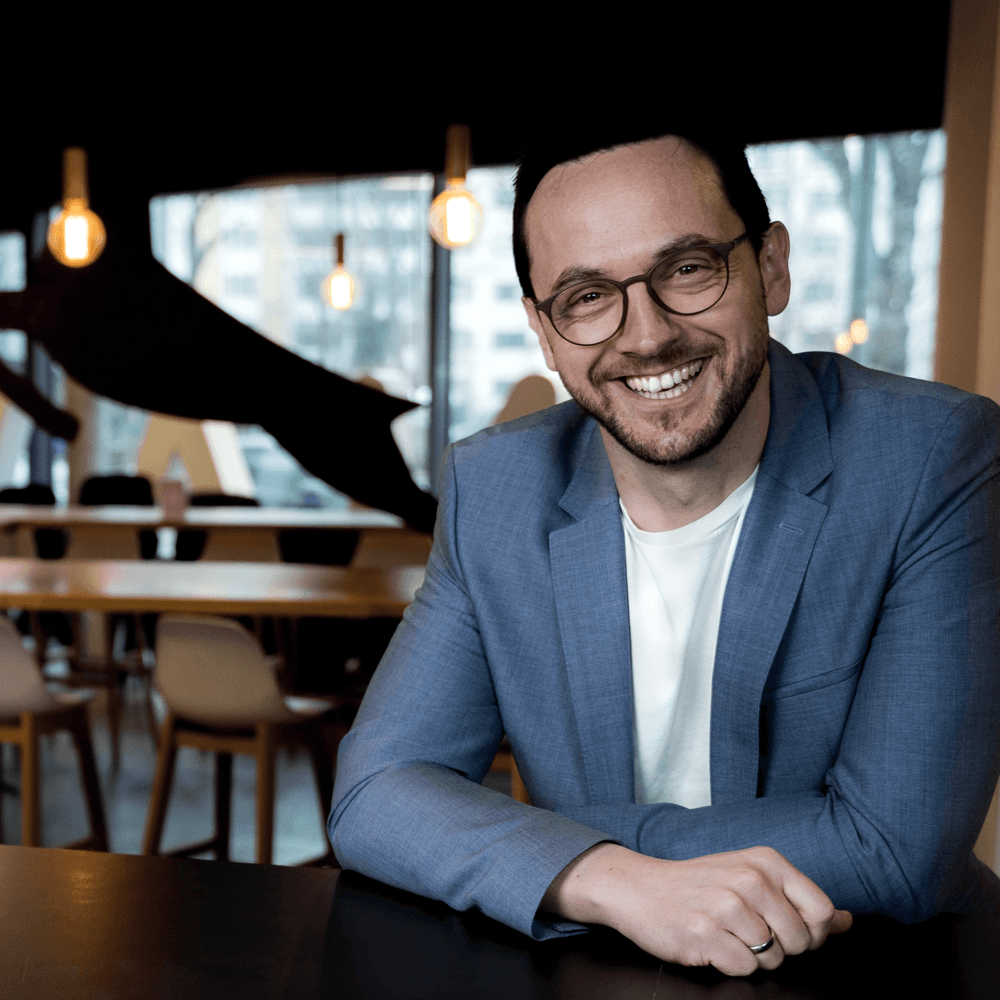
Willi Tscheschner
April 29, 2026
There’s a certain kind of founder story that only makes sense in hindsight. These stories are clean, intentional, and almost inevitable. Willi Tscheschner doesn’t tell that kind of story. His account of building Signavio is quieter and more grounded in reality. His story consists of a long chain of small decisions, steady execution, and a willingness to build in a space that didn’t attract much attention at the time.
After selling Signavio to SAP, Willi has restructured his life. What happens after an acquisition, and how do you live your life afterwards? Find out how Willi is navigating this today.
About Willi Tscheschner
Willi Tscheschner is best known as a co-founder and former CTO of SAP Signavio, where he helped build one of Europe’s leading process management platforms from the ground up. With a background in engineering and a strong focus on product and systems thinking, he spent over a decade scaling the company before its acquisition by SAP. Today, he is investing across Europe, focusing on B2B SaaS, climate deep tech, and social entrepreneurship. His approach is deliberately low-profile and founder-centric, emphasizing long-term value, adaptability, and supporting entrepreneurs in ways that suit their individual needs rather than imposing a fixed playbook.
About SAP Signavio
SAP Signavio is a process management and process intelligence platform that enables organizations to understand, optimize, and transform how they operate. Built initially in a category that lacked mainstream attention, the company steadily grew into a global leader serving large enterprises with complex operational needs. Its tools help businesses map workflows, analyze inefficiencies, and drive continuous improvement. This focus on substance over trend positioned Signavio as a key player in the rise of process mining and operational intelligence, ultimately leading to its acquisition by SAP.
“It rarely looks important when it’s happening”
Startup stories often rely on hindsight a little too much. Quite often in the retelling, the mess and the doubt disappear. Suddenly, what was actually eleven years of pressure, iteration, and second-guessing gets repackaged as a neat little origin story.
That is not how SAP Signavio was built, according to Willi.
What comes through in his version is something much more believable. In his eyes, there wasn’t one brilliant move or a single dramatic turning point. Instead, there were “tons of micro decisions,” stacked on top of each other over time, he says.
Some of those decisions mattered more than others, of course. But the big ones weren’t especially flashy. They were about people.
It might sound obvious, he states, but “it is amazing how often founders overlook this aspect of building a company.” Willi saw that the early hires didn’t just fill seats. They shaped the standards, pressure tolerance, and communication styles, and ultimately decided what kinds of behavior became normal when things got hard.
That’s where the company’s culture started. Not in a deck or a Notion page. In the beginning, when a few people decide how the company will feel. “Basically, we had great people from day one, we had a strong culture from day one, and I think when it got bigger, it was these things which kept us together.” For him, it was about “doing things you believe in and think are right.”
"If I categorize the first important tasks, the first is finding the right people. Starting with the founding team and the first hires, these are the most important decisions you will make."
Building in a difficult market
Willi says that “SAP Signavio started in a category almost no one thought was sexy back in 2009.”
Back then, the attention was elsewhere. E-commerce was booming. Consumer startups were louder, shinier, and much easier to sell as the future. Meanwhile, the Signavio team was building in process management.
Instead of chasing hype, they stayed in their lane. Process management was the world they actually understood. “For us, it felt right—we all came from process optimization and process intelligence, so it felt natural,” he relays.
Even the setting for their story says something. Signavio started in West Berlin, near Potsdam University. Back then, he says, “most startups started in the Eastern Berlin area. More in Mitte and the other more hipster areas.”
Maybe that mattered, maybe it didn't, he admits. But it certainly did not hurt to be different and a little further away.
"When we started, B2B was not really sexy. Everyone was doing e-commerce and building shops. People asked why we were doing process management."
“B2B has a way of humbling you”
“Unlike B2C, B2B isn’t flashy, it wins you over slowly,” says Willi. On the product side, the standards are high from day one. Enterprise customers don’t care how clever your vision sounds if the product is not secure, scalable, and reliable.
When talking about building a product in this space, Willi talks about “being rigorous” and building something “very solid and built to last for large organizations.” That was the job.
The hardest surprise came on the sales side.
Anyone who has sold into enterprise will feel this in their bones. The product can make perfect sense, and the sales cycle can still drag on forever. There are always too many stakeholders and too many approvals to chase. And, as Willi says, “everyone wants to make a decision, but most of them are not the actual users, so they don't get the real value of it. But still, they have to sign off on it.”
This kind of environment punishes impatience. You can’t use brute force to fight your way in. You have to be durable enough to survive it. Or, as Willi puts it, “you have to be very patient and very solid.”
"I never imagined sales cycles would take so long. Every deal is different, with special terms, especially in the early days."
“Focus is not a mindset, it is a structure”
According to Willi, people love talking about focus as though it is mainly about discipline. As though the answer is simply to want it more, prioritize harder, and stop getting distracted. But that’s only part of the story.
For Willi, a lot of focus comes from structure. If ownership of tasks is fuzzy, responsibilities overlap, and everyone is involved in everything, the company gets noisy fast. This is something that he and his team understood this early.
To streamline efforts, he says that “all the co-founders had their speciality in the organization from day one. I personally focused primarily on engineering and product, while others focused on sales and marketing.”
Crucially, though, this division of roles only works when the trust is genuine. And when it does work, it creates clarity as everyone knows what they’re working on. Things move faster because there is less internal drag.
"From day one, we divided responsibilities clearly among co-founders. I focused on engineering and product, others on sales and marketing."
The SAP deal was not some master plan
In January 2021, Signavio was acquired by SAP. One of the best things about Willi's account of the acquisition is that he doesn’t try to dress it up as destiny. “This wasn’t always the plan,” he explains. In this case, a window of opportunity opened, and the timing was right for a sale.
He is eager to point out that this is how many exits happen. “The market changed severely. It was still COVID, and we saw that the valuation was pretty high in the market and companies, including SAP, saw the benefit of process mining and intelligence.”
For Willi and the team, the answer came down to scale. Talking about the decision, he describes sitting together with his co-founders and asking, “What's best for the company? What's the best thing for the people working for us? This is where we all had to agree that, with SAP as a strong partner, we can be much, much bigger. We could have much, much more impact than doing it on our own.”
"You don’t actively plan for an exit; there just has to be a great opportunity.”
Staying after the deal
The deal itself was only half the story. What came next mattered too. Willi stayed on to help make the integration work. “It was important to make sure our people, products, and customers were integrated well,” he explains.
In his opinion, moving faster after an acquisition can sometimes be kinder on everyone. It reduces confusion and gets teams, products, and customers into the same place sooner.
Once the integration was done, though, his next decision became obvious. “I knew that being a part of SAP, we would have another high growth curve. This would have been very stressful for me to go through it all again. That's why I decided that I would love to take the time to be with my family, work on my own, and not be part of SAP anymore.”
When asked if it was difficult to adjust after having been part of a fast-growing company, he says, “I thought it would be harder, but even after 13 years with Signavio, every year would look different. Every year, my role changed, so I was used to change.”
“We wanted to integrate as fast as possible, because long periods of isolation in acquisitions often don't work well.”
Life after Signavio
A lot of founders exit and then immediately build another company. They take on more projects and more movement for the sake of movement. Willi, though, has gone in a more thoughtful direction.
“When I stepped out, I said, ' Okay, I've got 3 areas to focus on now. One is obviously my family. The second thing is myself: starting new hobbies and spending more time getting to know myself. And the third thing is taking responsibility for the experience I have gained and the financial freedom I have achieved. For me, it’s important to invest it in innovation here in Germany and Europe.”
“It was relatively easy for me to step out and change my role again in a more drastic way.”
Investing without ego
When it comes to his investment philosophy, he’s very clear that he doesn't want to turn himself into a product. Instead, his approach is pretty simple: it’s all about the founders.
As an investor, he recognizes that some founders want active involvement. Some want an occasional challenge. Some want space. The ability to read this properly is more useful than forcing the same support model onto everyone, he says.
What’s more, his focus areas tell their own story: B2B SaaS, climate deep tech, and social entrepreneurship. Different worlds, but not a random mix. They all sit somewhere near usefulness, resilience, and real-world consequences. “I don't think that we can change the world primarily with software, so that's why I also invest quite significantly in climate and deep tech.”
He also does a lot of fund investments, which he sees as being more “indirect", but going in the same direction. “I don’t want to fund traditional companies, I want to invest in innovation and young startups, and this gives me another way to do that.”
“Impact, for me, is about leaving a better world.”
On AI, the least annoying answer wins
On the topic of AI investing, he points out that “AI always comes with a caveat. As an engineer by education, AI for me is not a business per se, but rather a technology. At the moment, it still feels like some of the AI tools are just there for the sake of being there.”
AI can absolutely improve products. It can improve workflows, efficiency, and scale. But that does not automatically make it a business, he explains. Plenty of companies are still confusing technical capabilities with current value.
Instead, his position on AI is to use it where it makes sense, but don’t build an entire ideology around it. As he puts it, “the core is still building a good business.
“As an engineer, I see AI as a technology, not a business in itself.”
Quick-fire round
A tool you can’t live without?
“Besides communication, music, and podcasts, my running app. It helps me train for marathons.”
How do you recharge?
“Running. Even after long workdays, I would go for a run at night. It clears my mind."
Advice that stuck:
"I'm not really a person who takes advice. Most things are situational and complex. I prefer sharing experiences rather than giving generic advice."
Founder or start-up that you admire:
“Tina and Cedric from Better Ventures, and Philip von der Wippel from ProjectTogether.”
Life now
What’s interesting about this phase of Willi’s career is that it doesn't feel like reinvention. It feels more like refinement. He is still very much part of the ecosystem, still backing companies, still working with founders and still close to the action. But his energy has been redirected. For him, it’s less about building a spotlight and more about being useful where it matters.
That seems to be Willi's lane now. And for founders, that is probably good news. He’s open to conversations, open to helping, and open to doing serious work, not just with capital, but with time, perspective, and support where it is actually useful. Get in touch via his LinkedIn.